What's Your Brand Identity?
Your voice, your look, your practice.
If you're thinking, "What the heck is a brand identity?" I'm so glad you're here! Let's talk about it.
If you're joining the October MyoBloom Social Media Challenge and your brand voice and brand kit aren't sorted yet, start here. This is the foundation for everything you'll post over the next 28 days.
If you're not in the challenge yet, you should join us! Either way, this still matters for you.
OK...Your Brand Identity...
Your brand identity is how your practice sounds and looks everywhere it shows up: your website, social posts, patient handouts, signage, and the business card you hand to a provider. When it's consistent, people recognize you. When it isn't, you end up rebuilding your reputation from scratch every time someone sees your brand.
Think about it like this. A dentist hands your brochure to a patient. They glance at it in the moment and take it home to "look at later." A week later, they spot your sign on the office door while visiting a neighboring business and think, "Oh yes, I need to look into that." Then one night at 3 a.m., they're scrolling posts about why they can't sleep, and there you are. They recognize you instantly because your branding is consistent.
They've now seen you three times, not what could have looked like three different practices. That repetition builds authority and trust. They know exactly who you are, and they're much more likely to call you because of it.
Consistency makes your life easier, too. If you've ever sat down to make a post and spent twenty minutes trying four fonts, three shades of blue, and two versions of a caption that felt either too stiff or too silly, that isn't a creativity problem... it's a missing foundation. You know what's awesome? You only have to build that foundation once!
Part 1: Find Your Brand Voice
Your brand voice is the personality that comes through in everything you write: your website, your socials, your blog, your newsletter. It's even in your emails and the voicemail greeting you recorded three years ago and keep meaning to redo 🤣.
The easiest way to nail it down is to decide how you want to sound and represent your brand, then create a reference you can always come back to. These are the same questions I work through with myofunctional therapists when I set up their websites, social media, and blog posts.
Who you serve
Who are your clients? Toddlers, big kids, teens, adults, women, athletes? Many of us treat a range (niching down isn't for everybody), but your content might speak to a specific demographic.
What are your focus areas? Breathing, sleep, feeding, habit elimination? These are the keywords and concepts you'll use in your writing.
Your practice language
This is the part that makes your brand accurate to the way you run your practice, and makes sure you sound like you.
Clients or patients? Pick one as your default. Either is fine, but switching back and forth feels inconsistent.
Therapist or coach? What do you call yourself?
What do you call your visits? Are they sessions or appointments?
What are your services or programs called? Assessment or evaluation? Mini Myo or Growth Guidance? Discovery call or Q&A?
What do you want to avoid? These are the terms and topics you want to keep out of your writing, like "treatment," swallowing, or TMD.
How you sound
Do you have a slogan? A tagline or phrase that represents what your practice does, used on your website, business cards, and social bio. Something like "Good sleep begins with good breathing" tells people what you do or believe in with just a few words.
What's your tone? Think about how you want people to feel when they read your words. A clinical tone is evidence-forward and precise. A friendly tone is warm and conversational. A playful tone is energetic and fun. You might also be grounded, nurturing, encouraging, witty, calm, or straightforward. Most of us blend a few. The sweet spot is credible enough for providers to trust, approachable enough for a nervous parent, and clear enough for the adult who's been researching their symptoms for months.
What's your writing format?
Emojis: Sparingly or freely?
Length: Short and punchy, or longer for educational posts?
Grammar: Polished and correct, or loose and trendy (think lowercase captions, sentence fragments, and "okay but hear me out")?
These small choices add up to a recognizable feel.
Content pillars
Content pillars are the three to five themes you come back to again and again. They're what you want to be known for, and they keep you from staring at a blank screen wondering what to post. For a myo practice, they might look like:
Education: what myo is, signs to look for, how breathing affects sleep
Client wins: progress stories and testimonials (with written permission, always)
Tips for home: nasal hygiene, habit elimination support, self-assessment
Collaboration: your referral partners and the team approach to care
Behind the scenes: you, your space, and why you love this work
Recurring series bring your pillars to life and give your feed a rhythm. Think of a weekly myth vs. fact, a "did you know" tip, or a before-and-after day. Your followers start to look forward to them, and you always know what's coming next. Plus, you can reflect on what's working and what's not when you have a plan instead of throwing spaghetti at the wall to see what sticks.
Once it's written down, your brand voice document becomes the reference for anyone who writes for your practice, whether that's an assistant, a social media manager, or future you trying to come up with last-minute content.
Part 2: Build Your Visual Identity
Your visuals should match your voice. A playful pediatric practice in muted grays and a formal font sends mixed signals before anyone reads a word.
Start with this question: how would you describe your overall aesthetic? Clean, modern, minimal, warm, bold, soft, playful, nature, earthy, feminine, bright? Pick three or four. Those words will guide every choice below.
This is where the brochure, the sign, and that 3 a.m. scroll start working together. When your logo, signage, business cards, social posts, and website all share the same look, every encounter builds on the last one instead of starting over.
Choosing your colors
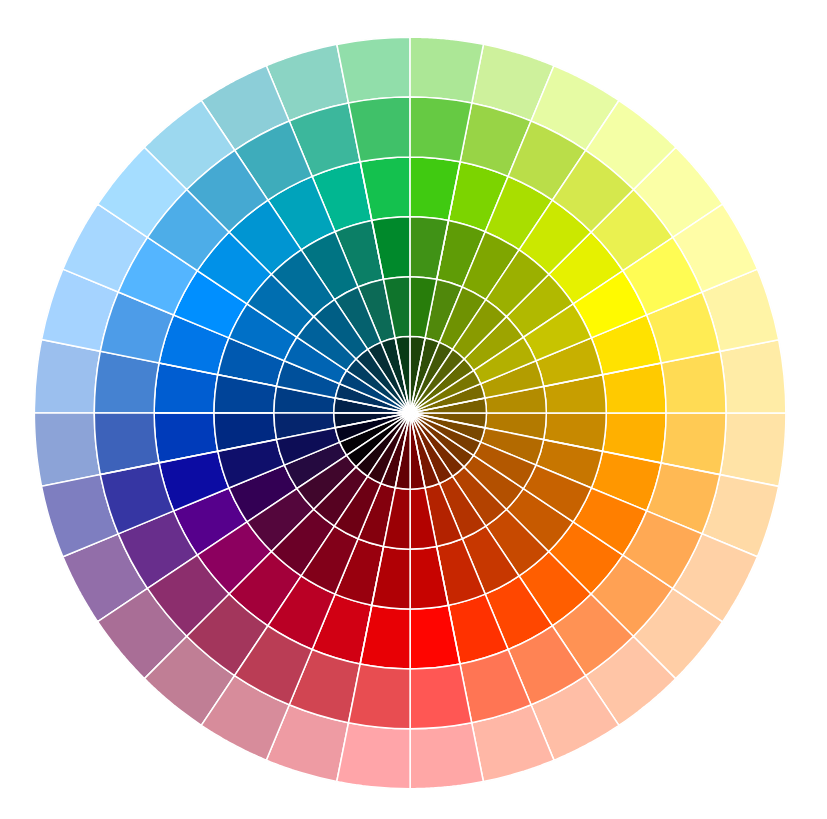
If you have a logo, start there. Your brand colors should come from it or support it. A color wheel helps here:
Complementary colors sit opposite each other, like blue and orange. They're high contrast and energetic.
Analogous colors sit side by side, like green, teal, and blue. They're calm and cohesive.
A simple rule of thumb is 60-30-10: 60% main color, 30% secondary color, and 10% accent for buttons, highlights, and calls to action.
Quick tip: If you don't know the exact colors in your logo, upload it to an AI chat and ask, "What are the hex codes of the colors in this logo?" You can also find your hex codes in Canva and other design tools if your logo and branding files live there.
Choosing your fonts

Stick to two or three fonts:
Heading font: where the personality lives, whether that's playful or elegant, or bold or fine.
Content/Body font: clean and easy to read. This one does the heavy lifting on handouts and exercise sheets.
Accent font (optional): a script or display font, used sparingly.
Readability always wins. If the reader has to squint at your text, the font isn't working.
Part 3: Set Up Your Brand Kit
A brand kit keeps your logo files, colors, and fonts in one place so they're easy to access every time you design. That place can be:
A simple document or PDF brand board
A folder on your computer or in Google Drive
Inside Canva or your preferred design app
Inside your website builder's theme or brand settings
My preferred home for my brand kit is Canva, and setting yours up if you haven't already is easy:
From your Canva home page, click Brand in the left sidebar.
Create a new brand kit and give it your practice name.
Upload your logo, including any variations like a submark, icon, greyscale, etc.
Add your brand colors using their hex codes.
Set your fonts for headings, subheadings, and body text.
Add any brand photos, graphics, or icons you use often.
Now, every time you open a design, your colors, fonts, and logos are one click away. Depending on your Canva plan, you can also save brand templates so every new design starts on-brand.
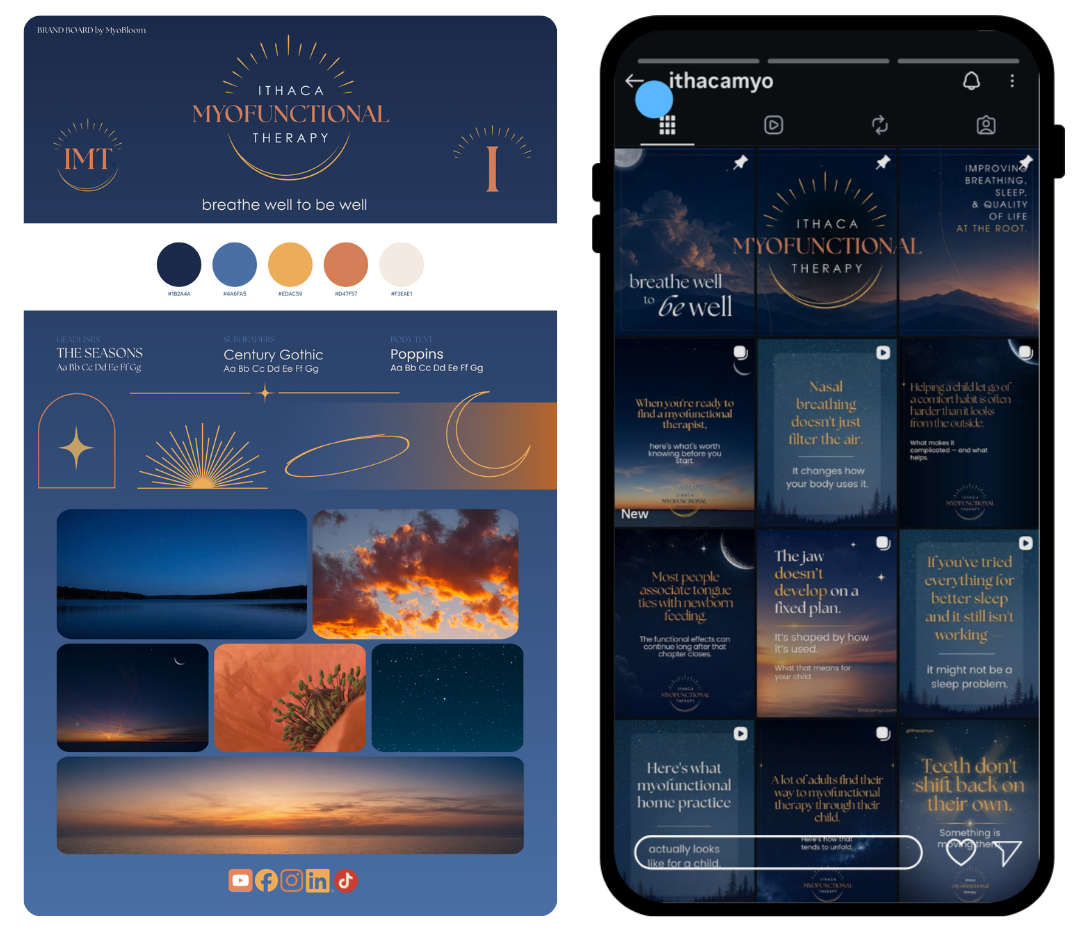
I follow this advice in my own myo practice (see above). MyoBloom, though, is its own work in progress. As a graphic designer, I have a hard time staying inside the lines. I love playing with visual interest, trends, and new aesthetics, so no, I'm not following the branding color and font guidelines like I probably should over here.🫣
My recommendation is to learn the brand identity standards discussed here and implement them first. Then decide where you might want to bend the rules.
Put Your Brand to Work: Join the Social Media Challenge
October is Social Media Month at MyoBloom, and the Social Media Challenge starts October 2. It runs 28 days: one prep week, then three weeks of daily actions to keep you motivated, inspired, and posting consistently.
Along the way, you'll:
Polish your platforms and make your practice easier to find
Collect assets you can use again and again
Connect with other OMTs in the community hub
Earn points and climb the leaderboard
The winner gets their registration fee back plus a full month of social media management from the MyoBloom Social Media team.
Join the Social Media Challenge →
Want Some Help?
Need a brand kit and social templates designed for you? Start a custom project →
Need a website that represents your brand? Explore website design →